


Education
2025 — 2027




Data and Artificial Intelligence
Master of Science
2022 — 2025

Computer Science
Bachelor of Science · Valedictorian
Opening the gallery

01 / Profile
I study how AI reasons, generalizes and earns trust
02 / Experience
Master of Science
Bachelor of Science · Valedictorian
NLP & Graph Methods
DIG Team · LTCI Lab
Computer Vision & Deep Learning
AND Team · DISC Dept
Unsupervised Learning
IMAGeS Team · D-IRTS Dept

RAG & Voice AI
Founding Team · Codage Tech
LLM Fine-Tuning & Evaluation
Model R&D · AITOM
Multi-agent AI & Data Platforms
Technology CoE · PASHA Life

HEC Paris deep-tech finalist among 300+ teams



Awarded for my MSc studies at Polytechnique Paris


FraudShield AI detects financial fraud with RAG



Ecoffin pairs engine fuel with a CO₂ dashboard

Invited as Innovation Mentor for 4.0, 5.0 & 6.0

Fine-tuned LLMs for Turkish-language understanding
11+ hackathon wins, that was fun :))
03 / Research
 Details & authors
Accepted for proceedings · Formal mathematics / semantic retrieval
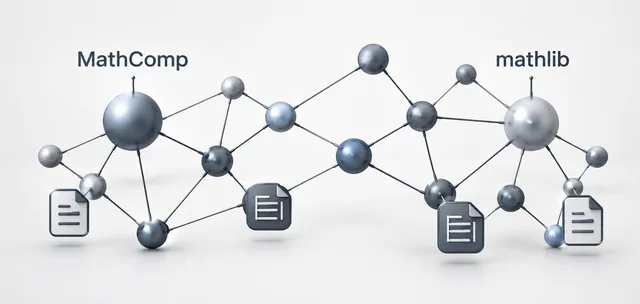
Retrieval between MathComp/Rocq and mathlib/Lean is not always a one-to-one matching problem. This work studies complementary module retrieval while preserving the primary result, accounting for content distributed across different library boundaries.
Methods
Semantic retrieval · Graph methods · MathComp / Rocq · mathlib / Lean
International Conference on Web Information Systems Engineering (WISE 2026) · Student Track
Primary-Preserving Complementary Module Retrieval Across Formal Mathematics Libraries
@inproceedings{hasanov2026modules,
  title = {Primary-Preserving Complementary Module Retrieval Across Formal Mathematics Libraries},
  author = {Hasanov, Elgun and Bashirov, Fatulla and El Kadhi, Nahla},
  year = {2026},
  booktitle = {WISE 2026, Student Track}
} Details & authors
Accepted full paper · Biomedical AI / external validation
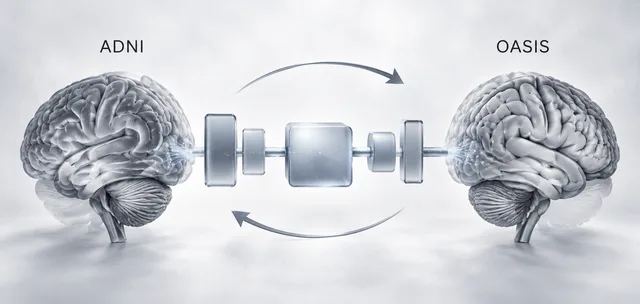
A bidirectional external-validation study of Alzheimer's disease classifiers across independent clinical cohorts.
Methods
External validation · Distribution shift · Biomedical AI
IEEE International Symposium on Computer-Based Medical Systems (CBMS 2026)
Asymmetric Cross-Cohort Generalization in Alzheimer's Disease Classification: A Bidirectional External Validation Study
@inproceedings{hasanov2026asymmetric,
  title = {Asymmetric Cross-Cohort Generalization in Alzheimer's Disease Classification: A Bidirectional External Validation Study},
  author = {Hasanov, Elgun and El Kadhi, Ayman and Safarli, Gulzar and El Kadhi, Nahla},
  year = {2026},
  booktitle = {IEEE International Symposium on Computer-Based Medical Systems}
} Details & authors
Accepted for oral presentation and proceedings · Paper 337
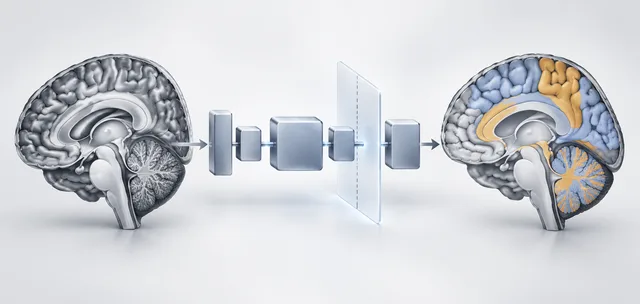
A leakage-safe machine-learning evaluation across ADNI and OASIS with external validation.
Methods
External validation · Distribution shift · Biomedical AI
KES International Conference
Leakage-Safe Machine Learning for Alzheimer's Disease Classification with External Validation on ADNI and OASIS
@inproceedings{hasanov2026leakagesafe,
  title = {Leakage-Safe Machine Learning for Alzheimer's Disease Classification with External Validation on ADNI and OASIS},
  author = {Hasanov, Elgun and El Kadhi, Ayman and Safarli, Gulzar and El Kadhi, Nahla},
  year = {2026},
  booktitle = {KES International Conference}
} Details & authors
Accepted for presentation · Mental-health NLP / interpretable attention
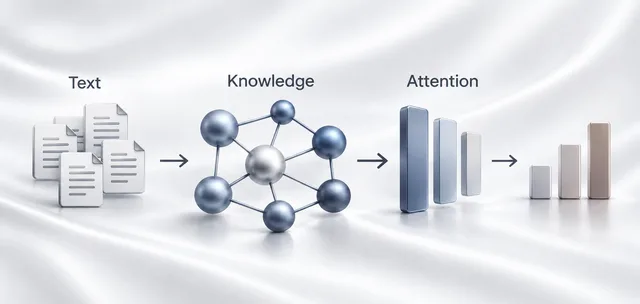
A knowledge-infused attention approach for interpretable depression-severity assessment from social-media text.
Methods
Attention · Knowledge infusion · Mental-health NLP
Earlier version available as an arXiv preprint.
International Conference on Web Information Systems Engineering (WISE 2026) · Main Research Track
AttentionDep: Knowledge-Infused Attention for Interpretable Depression Severity Assessment from Social Media
@inproceedings{hasanov2026attentiondep,
  title = {AttentionDep: Knowledge-Infused Attention for Interpretable Depression Severity Assessment from Social Media},
  author = {Ibrahimov, Yusif and Anwar, Tarique and Yuan, Tommy and Mutallimov, Turan and Hasanov, Elgun},
  year = {2026},
  booktitle = {WISE 2026, Main Research Track}
} Details & authors
Published · Open access · LLM reliability / causal analysis
An analysis of Qwen2.5-7B's attention in mental-health classification examines whether predictive signals align with domain reasoning. The work identifies a limitation in attention-based causal discovery and studies a correction using contrastive TF-IDF and directed pointwise mutual information.
Methods
Causal analysis · Trustworthy AI · Qwen2.5-7B
Artificial Intelligence for Digital Transformations (AIDT) · pp. 251–263 · DOI: 10.1007/978-3-032-31319-5_17
Can We Trust LLMs for Mental Health-Based Decisions? A Causality Aware Reliability Analysis
@inproceedings{hasanov2026trustllms,
  title = {Can We Trust LLMs for Mental Health-Based Decisions? A Causality Aware Reliability Analysis},
  author = {Ibrahimov, Yusif and Mutallimov, Turan and Mirzabayov, Seymour and Hasanov, Elgun},
  year = {2026},
  booktitle = {Artificial Intelligence for Digital Transformations (AIDT)},
  doi = {10.1007/978-3-032-31319-5_17}
} Details & authors
Published · Ensemble clustering / decision support
The framework combines complementary clustering signals while accounting for feature structure, aiming to produce more robust groupings for complex data-analysis workflows.
Methods
Ensemble clustering · Decision support
International Conference on Decision Aid Sciences and Applications (DASA) · pp. 980–986 · DOI: 10.1109/DASA68193.2025.11498998
Decision Support through Feature-Aware Ensemble Clustering: A Multi-Algorithm Fusion Framework for Complex Data Analysis
@inproceedings{hasanov2025ensemble,
  title = {Decision Support through Feature-Aware Ensemble Clustering: A Multi-Algorithm Fusion Framework for Complex Data Analysis},
  author = {Hasanov, Elgun and El Kadhi, Nahla El Zant},
  year = {2025},
  booktitle = {International Conference on Decision Aid Sciences and Applications (DASA)},
  doi = {10.1109/DASA68193.2025.11498998}
} Details & authors
Published · Medical imaging / explainable ML
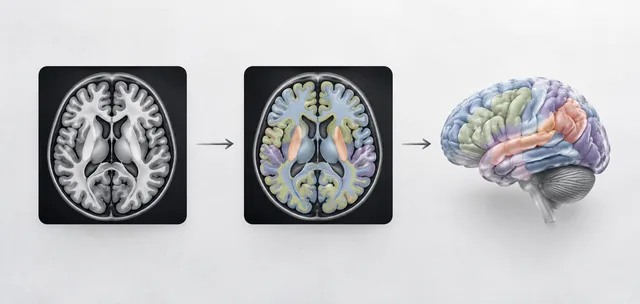
This project connects FastSurfer-derived neuroanatomical features with interpretable machine-learning models to support rapid Alzheimer's disease classification.
Methods
FastSurfer · Explainable ML · Brain segmentation
International Conference on Decision Aid Sciences and Applications (DASA) · pp. 1527–1535 · DOI: 10.1109/DASA68193.2025.11499040
Rapid Automated Alzheimer's Disease Classification Using FastSurfer Segmentation and Explainable Machine Learning
@inproceedings{hasanov2025fastsurfer,
  title = {Rapid Automated Alzheimer's Disease Classification Using FastSurfer Segmentation and Explainable Machine Learning},
  author = {Safarli, Gulzar and El Kadhi, Ayman and Hasanov, Elgun and El Zant El Kadhi, Nahla},
  year = {2025},
  booktitle = {International Conference on Decision Aid Sciences and Applications (DASA)},
  doi = {10.1109/DASA68193.2025.11499040}
} Details & authors
Preprint · Earlier version of the WISE 2026 AttentionDep paper
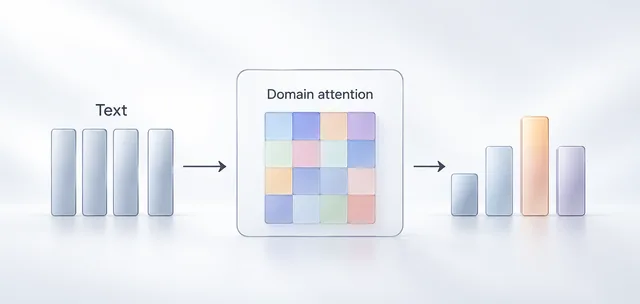
A domain-aware attention model that combines contextual text representations with mental-health knowledge for interpretable, ordinal depression-severity assessment.
Methods
Attention · Knowledge infusion · Mental-health NLP
Earlier version of the WISE 2026 AttentionDep work.
arXiv preprint arXiv:2510.00706 · DOI: 10.48550/arXiv.2510.00706
AttentionDep: Domain-Aware Attention for Explainable Depression Severity Assessment
@article{ibrahimov2025attentiondep,
  title = {AttentionDep: Domain-Aware Attention for Explainable Depression Severity Assessment},
  author = {Ibrahimov, Yusif and Anwar, Tarique and Yuan, Tommy and Mutallimov, Turan and Hasanov, Elgun},
  year = {2025},
  journal = {arXiv preprint arXiv:2510.00706},
  doi = {10.48550/arXiv.2510.00706}
}No matching publications. Try another title or research area.
*conceptual previews, powered by imagination :)
04 / Blog
Practical guides and research notes on building and evaluating AI systems.
A practical starting point for supervised fine-tuning: define the task, prepare data, train an adapter, and evaluate the result.
Read article ↗02How to keep information from the test set out of preprocessing, model selection, and reported results.
Read article ↗03A practical way to think about external validation, distribution shift, and the limits of internal scores.
Read article ↗

 Google Scholar
 BibTeX
 Paper
Paper Code
Code